
New roofs
A strip and reroof takes the old covering back to the rafters and builds it up again: timbers checked and repaired, new membrane and battens, then slate or tile laid to the right gauge with mechanically fixed ridges and verges. It is the one point in a roof’s life when everything underneath is open to look at.
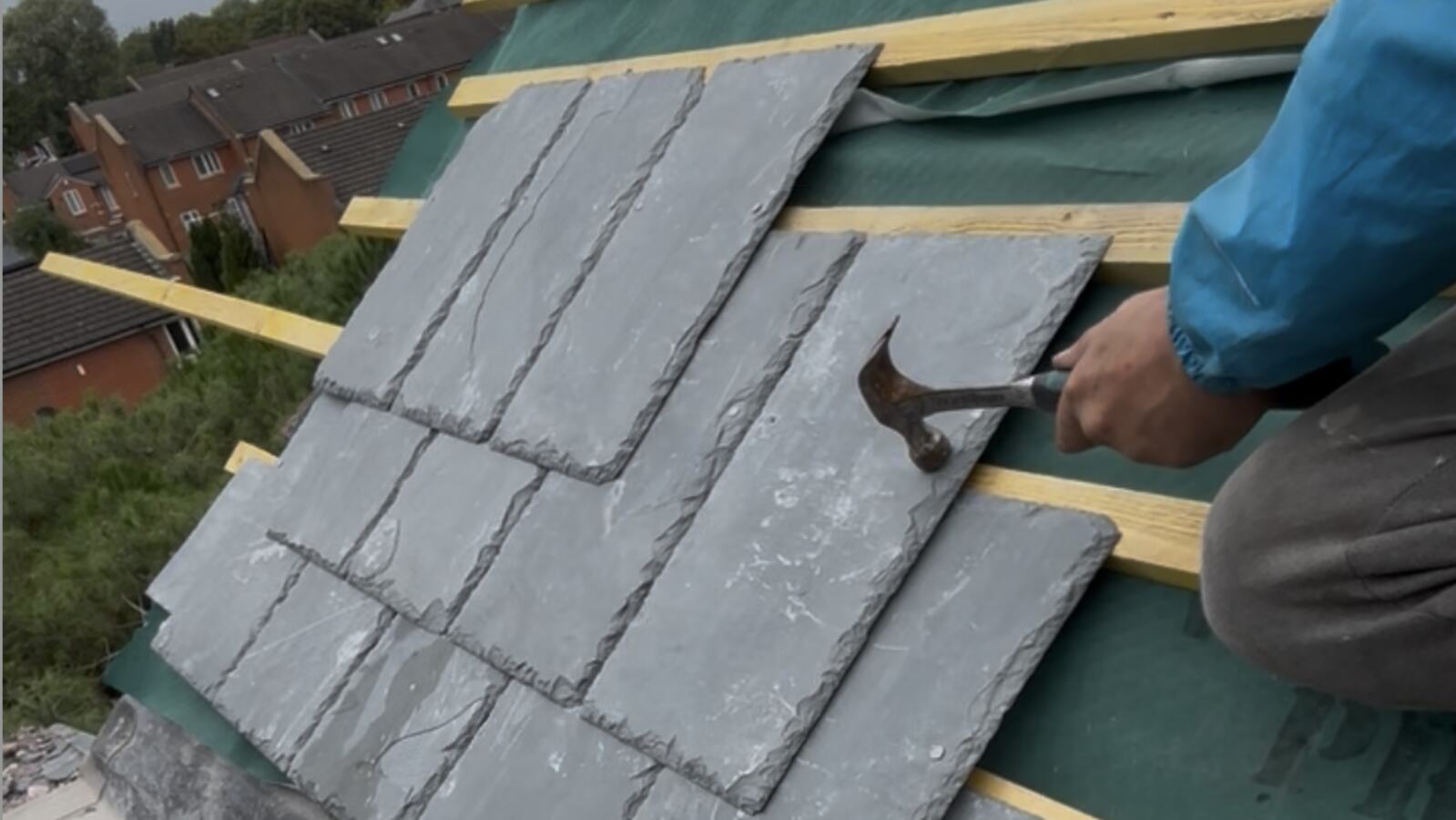
What a strip and reroof involves
The scaffold goes up first, with a working platform at the eaves and edge protection round it. Expect it to stay for the length of the job and a little either side.
The old covering comes off down to the rafters, with the old underlay and battens. Sound slates can be set aside for reuse if the roof is going back in slate, though on an older roof the share worth saving is often lower than people hope. With the rafters exposed they are checked for rot, beetle, sag and spread, and anything that needs repairing or strengthening is dealt with before the roof goes back on. You will see photographs of what was found before it is covered up again.
The roof is stripped in sections it can be made watertight from at the end of each day, and a temporary covering goes on when the weather turns. There is noise and dust while the old roof comes off, so clear anything you value out of the loft beforehand. Lead flashings, soakers and back gutters are normally renewed rather than reused, and it is the cheapest time to replace gutters and fascias too, while the scaffold is there.
Membrane, battens and ventilation
Plenty of older roofs round here have no underlay at all, or a bitumen felt that has gone brittle and torn where it sags between the rafters. The replacement is a breathable membrane, which lets water vapour out of the roof space while keeping wind-driven rain and snow out. Treated battens go over it at a gauge set by the slate or tile and the pitch of the roof.
Ventilation is the part most often got wrong. A roof space needs air moving through it, usually in at the eaves and out at or near the ridge, or condensation forms on the cold side of the membrane and drips back onto the insulation and ceilings. How much ventilation a breathable membrane still needs depends on the product and the roof, so it gets worked out for the roof in front of you rather than assumed.
Slate or tile
Natural slate is the traditional covering on much of the older housing around Lancaster, Morecambe and the South Lakes. It lasts, it suits the buildings, and on some properties, particularly in conservation areas, it may be expected. It is also the dearer covering to buy and to lay. Slate quality varies a good deal between quarries, so the slate on a quote is named, not just described as “natural slate”.
Clay and concrete tiles cost less to lay and suit a lot of post-war and newer housing. Concrete tiles are heavier than slate, so going from slate to concrete tile can mean the rafters need checking or strengthening to carry the extra weight. Fibre cement slates are lighter and cheaper again, and look like slate from the street, but they do not last as long.
Ridges, hips and verges used to be bedded in sand and cement. Mortar cracks with movement and weather, and once it lets go a ridge tile or a verge can lift in high wind. Current practice is to fix them mechanically: dry ridge and dry verge systems are screwed or clipped to the roof, with nothing to crack, and need far less looking after.
More on roofing Roofing Flat roofs Roof repairs Roof assessment before you buy Estate agents & property management
Free written quote
Send the details.
Quickest way is still the phone — 0800 008 6573. If it’s easier to write it down, use this.